
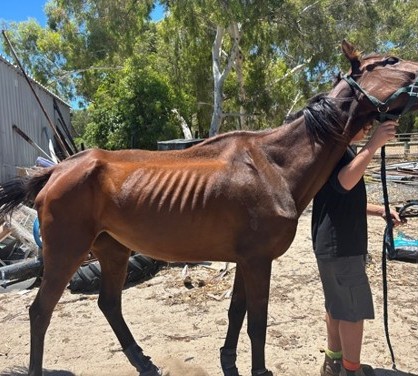
Port Kennedy man convicted over emaciated horse
A 41-year-old Port Kennedy man has been fined $4,200 and banned from being in charge of horses for three years for failing to feed his six-year-old mare appropriately, leaving her emaciated.
He has also been ordered to pay $12,815 in care and legal costs.
The Mandurah Magistrate’s Court heard RSPCA WA inspectors went to the offender’s Bouvard property in December last year after receiving a report about a six-year-old mare who appeared emaciated with no access to food, water, or shelter.
The offender told inspectors the horse, named Daisy, had become ill after eating weeds about a month prior but was now “on the mend”. She had not been seen by a vet – the offender said he and a neighbour had given Daisy ginger and warm water to help her digestive system.
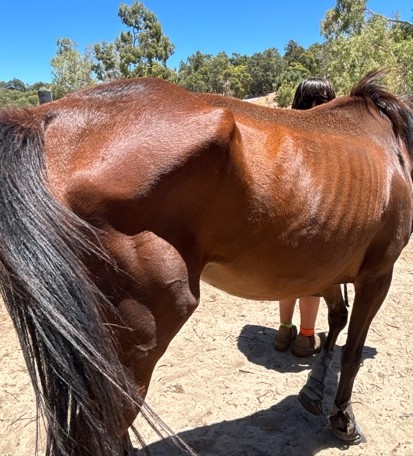 While at the property, the inspectors noted Daisy was lethargic, with the outline of her ribs, hip bones and spine prominent. They couldn’t see any hay in the paddocks, the hay shed was empty apart from small hay remnants on the floor, and the feed shed contained just a handful of horse muesli in a tub and empty horse feed bags.
The inspectors seized Daisy due to suspected offences under the Animal Welfare Act 2002 and took her to a vet clinic for immediate assessment.
She weighed just 363kg with a body condition score of 2/9 (5 being optimal). The vet reported that no single underlying medical condition was identified that would account for Daisy’s severe loss of body condition and that, based on the clinical findings, diagnostic investigations, and absence of significant disease, the most likely cause of her emaciated state was chronic malnutrition.
Daisy stayed under vet care for 11 days and gained 15kgs in that short space of time. She was then placed with a foster carer and has now fully recovered.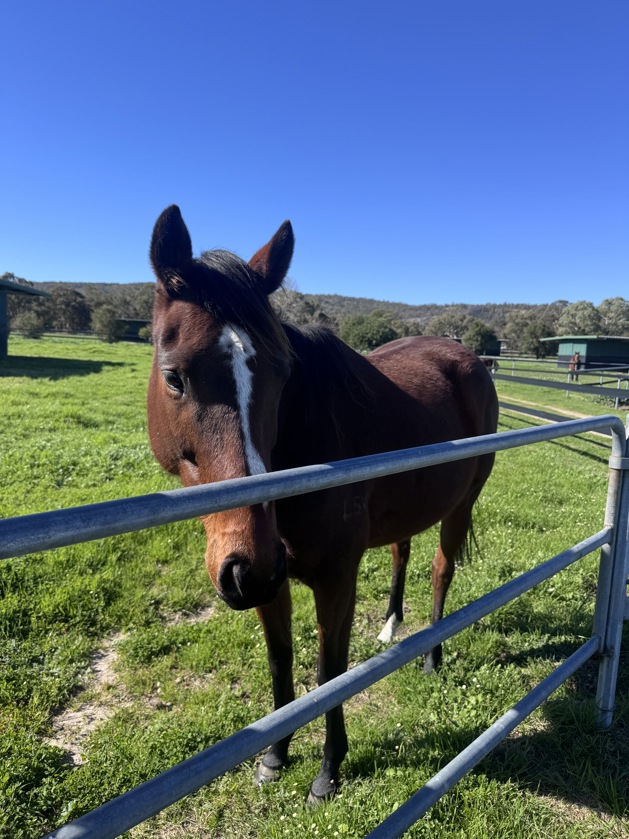
RSPCA WA Inspector Manager Kylie Green said she’ll never get used to seeing emaciated animals.
“It’s impossible to comprehend how anyone could see Daisy in the state she was in and either think that’s ok, or know it’s not ok but do nothing about it,” she said.
“To think of poor Daisy standing in those bare paddocks day after day, starving but with nothing to eat is just heartbreaking.”
“Daisy, like all animals, deserves better. They rely on us to look after them properly and if we can’t, to ask for help from someone who can.”
The offender was convicted under sections 19(1) and 19(3)(d) of the Animal Welfare Act 2002.
The maximum penalty for an animal cruelty conviction in Western Australia is a $50,000 fine and five years’ imprisonment.
The RSPCA relies on the community to report suspected cruelty and neglect. Reports can be made on 1300 CRUELTY (1300 278 358) or online at rspcawa.org.au.
Posted on in Animal cruelty, News